
Monday | 27th April 2026
The war in Iran has triggered a cascading global energy shock, sending oil-dependent economies into urgent search of alternatives. As traditional fuel supplies tighten and prices swing unpredictably, governments are accelerating plans that, until recently, were considered long-term transitions. At the center of this shift is China, whose dominance in renewable energy technology is rapidly transforming it from a manufacturing powerhouse into a cornerstone of global energy security.
Chinese exports of solar panels, batteries, and electric vehicles surged to record levels in March, according to energy think tank Ember. The spike reflects more than just strong demand—it signals a structural shift in how countries respond to fossil fuel disruptions. What began as a geopolitical crisis is now accelerating a global pivot toward cleaner, domestically controllable energy systems.
The turning point came in late February, when the United States and Israel launched airstrikes targeting Iranian positions. In response, Iran effectively sealed off the Strait of Hormuz—a narrow but critical maritime corridor through which roughly 20% of the world’s oil and gas supply flows. The blockade immediately rattled global markets, driving up prices and injecting uncertainty into supply chains already strained by years of geopolitical tension and post-pandemic recovery.
For energy-importing nations—particularly across Asia—the disruption has been acute. Countries heavily reliant on Middle Eastern النفط have scrambled to implement emergency measures, from reducing industrial energy consumption to shortening workweeks. But these stopgap solutions are increasingly being paired with more strategic investments in renewable infrastructure.
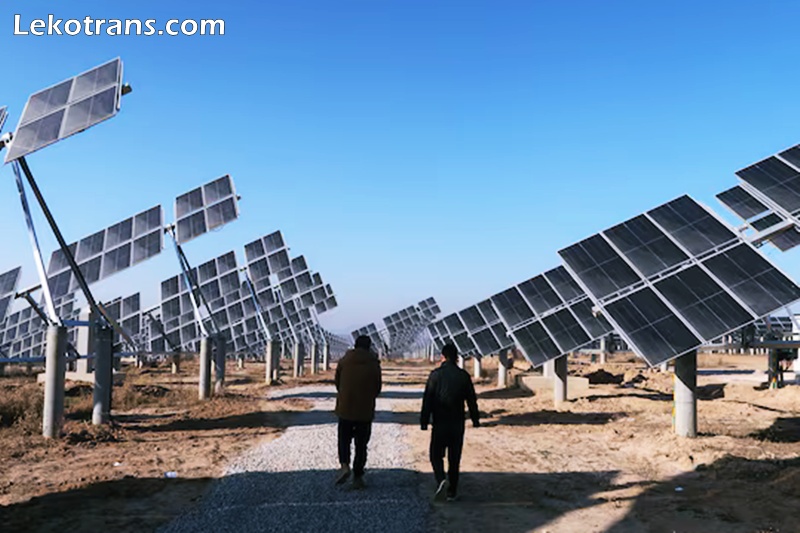
That’s where China’s influence becomes decisive. The country is already the world’s largest producer of solar panels, wind turbines, and electric vehicles. In March alone, China exported 68 gigawatts of solar technology—shattering previous records by a wide margin. According to Ember, 50 countries hit new highs in imports of Chinese solar products, with the fastest growth seen in emerging economies across Asia and Africa—regions hardest hit by the energy crunch.
“Fossil shocks are boosting the solar surge,” said Euan Graham, senior analyst at Ember. “Solar has already become the engine of the global economy, and now the current fossil fuel price shocks are taking it up a gear.” His assessment underscores a broader trend: crises that disrupt fossil fuel supply are increasingly acting as catalysts for renewable adoption rather than temporary setbacks.
The surge extends beyond solar. China’s exports of batteries and electric vehicles—collectively known domestically as the “new three”—rose by 70% year-over-year in March. These sectors are now central to China’s economic growth model, replacing traditional export drivers like textiles and household goods. Battery exports alone reached $10 billion, with particularly strong demand from the European Union, Australia, and India.
This transformation is not accidental. Years of heavy state investment have allowed China to build a vertically integrated clean energy supply chain, from raw materials processing to final product manufacturing. The result is not just cost competitiveness, but strategic leverage. As more countries adopt Chinese-made technology, Beijing’s role in the global energy ecosystem deepens.
Meanwhile, uncertainty around the Strait of Hormuz continues to fuel anxiety. Although a tentative ceasefire between the United States and Iran has opened the door for negotiations, the situation remains fragile. Naval confrontations and ship seizures have kept the passage effectively constrained, preventing a full return to normal trade flows.
The ripple effects are reshaping global alliances and trade patterns. Countries are no longer just seeking cheaper energy—they are prioritizing resilience. Renewable energy, once framed primarily as a climate solution, is now being recast as a national security imperative.
This sentiment was echoed by Ed Miliband, who warned that repeated fossil fuel shocks have exposed the vulnerabilities of traditional energy systems. “The era of fossil fuel security is over,” he said, emphasizing the urgency of transitioning to cleaner, more reliable sources.
Some countries are already seeing tangible benefits from early adoption. Pakistan, for example, has significantly reduced its exposure to oil price volatility by aggressively importing low-cost Chinese solar panels in recent years. The shift is estimated to save the country billions annually—funds that would otherwise be spent on fuel imports.
Analysts say this marks a deeper paradigm shift. According to Jeong Won Kim of the Energy Studies Institute at the National University of Singapore, China is no longer viewed merely as a low-cost supplier, but increasingly as a long-term partner in the global energy transition.
Electric vehicles are also playing a growing role in reducing oil dependence. Ember estimates that global EV adoption cut oil consumption by approximately 1.7 million barrels per day last year. As fuel prices surged following the Middle East conflict, Chinese EV manufacturers reported a sharp increase in overseas demand—further reinforcing the link between energy insecurity and clean technology uptake.
In effect, the crisis has compressed what might have been a decade-long transition into a matter of years. The geopolitical shock has not only disrupted the fossil fuel market—it has accelerated the rise of a new energy order, one where renewables are no longer optional, and where China sits firmly at the center.