
Monday | 18th May 2026
International cave divers have arrived in the Maldives to intensify the search for the remains of four Italian scuba divers who disappeared inside a deep underwater cave system, as the operation enters a dangerous new phase following the death of a military rescuer during recovery efforts.
The tragedy has shaken the Indian Ocean island nation and stunned the international diving community, with officials describing it as the deadliest diving accident in Maldivian history.
Five Italians were killed while exploring a submerged cave in the remote Vaavu Atoll on Thursday, triggering a massive multinational rescue and recovery operation involving the Maldivian coastguard, military divers, and international cave-diving specialists.
So far, only one body has been recovered.
According to Maldives chief government spokesperson Mohamed Hussain Shareef, the body of diving instructor Gianluca Benedetti was discovered near the entrance of the cave system, leading authorities to believe the remaining four victims are still trapped deeper inside the labyrinth-like underwater network.
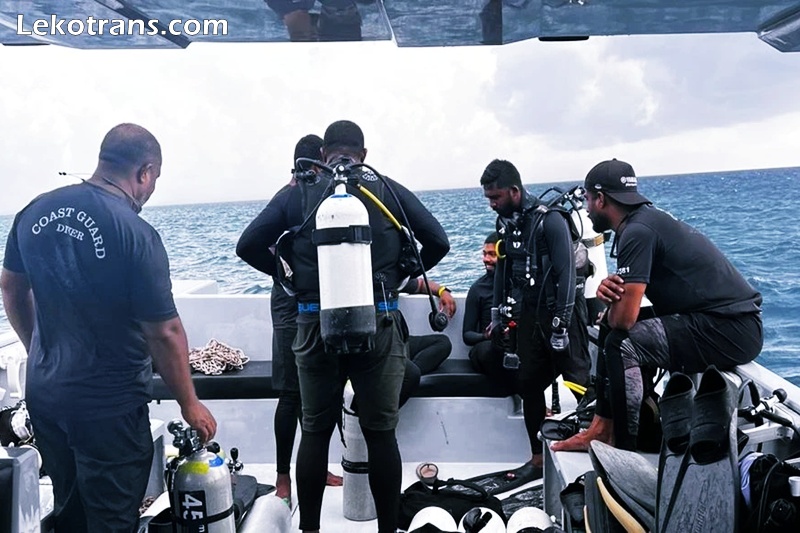
To assist with the increasingly difficult mission, three Finnish cave divers affiliated with the global scuba safety organization Divers Alert Network (DAN) arrived in the Maldives on Sunday. They joined a fourth international specialist and local coastguard teams to develop a revised recovery strategy aimed at navigating the treacherous underwater environment.
Shareef said specialist equipment is also being supplied by the United Kingdom and Australia to support the operation.
Authorities were evaluating weather and sea conditions on Monday before deciding whether divers could safely launch a third recovery attempt.
The four Italians still missing have been identified as Monica Montefalcone, an associate professor of ecology at the University of Genoa; her daughter Giorgia Sommacal; marine biologist Federico Gualtieri; and researcher Muriel Oddenino.
Officials confirmed that a sixth diver who had been part of the expedition chose not to enter the water when the others began the dive.
The group had been traveling aboard the diving vessel Duke of York as part of a scuba diving expedition organized through an Italy-linked tour operation, according to Italy’s foreign ministry.
Following the tragedy, the Red Crescent offered psychological first aid support to approximately 20 Italians still aboard the vessel. Authorities said no additional injuries had been reported among the remaining passengers or crew.
The already perilous operation became even more tragic when a senior Maldivian military diver lost his life attempting to retrieve the missing victims.
Sergeant Mohamed Mahudhee, a 43-year-old member of the Maldives National Defence Force and one of the country’s most experienced divers, died on Saturday during the second recovery mission into the cave.
Officials said the cave reaches depths of about 70 meters (230 feet) below the surface — roughly equivalent to the height of a 20-story building — and stretches approximately 200 meters in length through narrow, twisting underwater passageways.
“He was one of the most senior divers, which shows just how challenging this dive is,” Shareef said.
Authorities believe Mahudhee died from decompression sickness, a potentially fatal condition caused by a rapid reduction in surrounding pressure during ascent from deep water.
The condition, commonly known as “the bends,” most often affects scuba divers and deep-sea divers when dissolved gases — mainly nitrogen — form dangerous bubbles inside the body due to improper decompression.
According to officials, every dive in the recovery operation is restricted to around three hours because of oxygen limitations and the lengthy decompression procedures required after ascending from such extreme depths.
The environment inside the cave has been described as exceptionally hazardous.
Divers are battling strong and unpredictable underwater currents, extremely narrow passages, near-total darkness, and thick silt that can instantly reduce visibility to zero if disturbed.
“You have to be an expert for this level of diving,” Shareef said.
During Saturday’s mission, recovery divers reportedly marked the cave entrance by sending a balloon to the surface, allowing support teams to identify the location and reduce time spent navigating underwater.
Before resurfacing fully, divers must remain in shallower water for extended decompression stops to allow gases to safely leave the body.
Officials believe Mahudhee encountered complications during that decompression process.
“He was diving in a pair, as per protocol, and returning to the surface when his partner realized something was wrong and the rest of the team jumped in to try and save him,” Shareef explained.
Mahudhee was later laid to rest with full military honors in the capital Malé. Thousands attended the funeral ceremony, including President Mohamed Muizzu, military officials, tourism leaders, diplomats, and members of the public.
The Maldives, one of the world’s most famous diving destinations, maintains extensive maritime safety systems due to its geography, with ocean territory estimated to be roughly 3,000 times larger than its land area.
Still, experts say the conditions involved in this operation are among the most difficult imaginable.
British cave rescue expert John Volanthen, who helped rescue the trapped Thai youth soccer team in 2018, said the depth and sediment inside the cave are severely complicating efforts.
“It’s essentially a very long way into the cave,” Volanthen told CNN.
He explained that cave divers typically use guide lines to navigate complex underwater systems and safely retrace their path back to the entrance.
“It’s potentially what happened with the missing party,” he said.
Volanthen added that divers at such depths are also vulnerable to nitrogen narcosis, a condition sometimes described as feeling intoxicated underwater due to breathing compressed air under high pressure.
“It also makes it more likely that you’re inebriated or essentially unable to control yourself,” he said.
According to Volanthen, narcosis can trigger panic, confusion, and impaired judgment — all of which become especially dangerous inside a cave system where visibility may disappear entirely if silt is disturbed.
“And also, if the cave becomes silty, as is normal for this type of cave if you touch the walls or the floor, finding the way out becomes much more difficult,” he added.
The victims’ families remain desperate for answers.
Carlo Sommacal, husband of Monica Montefalcone and father of Giorgia Sommacal, told Italian television he could not understand how such an accident could have happened given their extensive diving experience.
He described his wife as an exceptionally disciplined diver who would never knowingly endanger herself, her daughter, or others.
“Something must have happened down there,” he said.
He also recalled how Montefalcone once survived the devastating 2004 Indian Ocean tsunami while diving off the coast of Kenya.
As recovery efforts continue, investigators are also examining whether the dive itself violated Maldivian diving regulations.
“For recreational and commercial diving, by law, nobody is allowed to go further than 30 meters and unfortunately, this appears to have happened a lot deeper because even the cave’s mouth is almost 50 meters under,” Shareef said.
Authorities have suspended the license of the expedition vessel pending the outcome of the investigation.
Italian tour operator Albatros Top Boat, which marketed the diving cruise, has denied authorizing or knowing about any deep dive beyond legal recreational limits.
Its lawyer, Orietta Stella, told Italian media that the operator “did not know” the group planned to descend below 30 meters — a threshold that requires special authorization from Maldivian maritime authorities.
She said the divers appeared to be using standard recreational scuba equipment rather than specialized technical gear designed for deep cave diving.
Stella also clarified that the company only promoted the trip and neither owned the vessel nor directly employed the crew, who were hired locally.
Meanwhile, Italy’s foreign minister Antonio Tajani said Italian authorities would do everything possible to recover and repatriate the victims’ remains.
The disaster has resonated deeply in the Maldives, where tourism is the backbone of the economy.
The island nation welcomed more than 2 million tourists in 2025 despite having a resident population of only about 500,000 people.
Italy has long maintained a close relationship with the Maldives tourism industry dating back to the early 1970s, when Italy-based diving operator George Corbin helped introduce organized tourism to the archipelago.
Since then, Italian travelers have remained among the country’s most significant visitor groups.
“Italy has a very special relationship with us when it comes to tourism, and we’ve been great friends in our hospitality for many years,” Shareef said.
“Local people are devastated not just because this is the biggest diving accident ever in this country but also because they are Italians.”
The Maldivian and Italian governments remain in close contact, with President Muizzu conveying condolences to Italian President Sergio Mattarella and to the families of the victims.
Italy’s ambassador to the Maldives also joined coastguard crews aboard a rescue vessel as the search operation continued.