
Tuesday | 10th March 2026
Newly surfaced video footage appears to shed further light on a deadly strike in southern Iran that killed scores of schoolchildren, raising fresh questions about who was responsible for the attack and how it unfolded. The footage, published by the semi-official Iranian outlet Mehr News Agency, appears to show a missile striking a naval facility operated by the Islamic Revolutionary Guard Corps (IRGC) near the coastal city of Minab.
The video, reportedly filmed from a nearby construction site on February 28, captures the moment a missile slams into a location inside the IRGC naval base. Weapons experts who reviewed the footage say the munition’s shape and flight characteristics are consistent with an American BGM-109 Tomahawk—a long-range land-attack cruise missile commonly referred to as a Tomahawk.
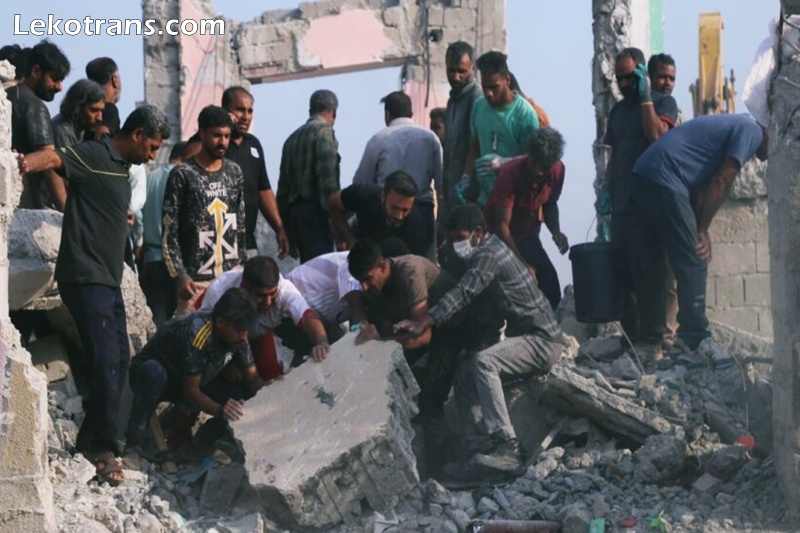
Shortly after the missile impact, the camera pans to the right, revealing a towering column of smoke rising from the direction of the Shajareh Tayyiba School. Iranian state media report that the school was devastated in the strike, leaving at least 168 children and 14 teachers dead, making it one of the deadliest single incidents involving civilian casualties in the current escalation.
Video Raises Questions About Responsibility
The emergence of the footage adds to a growing body of evidence that challenges statements made by Donald Trump, who suggested Iran itself was responsible for the attack. Speaking to reporters over the weekend, Trump claimed that Iranian weapons were likely to blame.
“Based on what I’ve seen, that was done by Iran,” Trump said, adding that Iranian munitions are “very inaccurate.”
However, officials within his administration have taken a more cautious approach, refraining from directly assigning responsibility while investigations continue. When questioned about the president’s comments, Pete Hegseth said authorities were still reviewing the incident.
“We’re certainly investigating, but the only side that targets civilians is Iran,” Hegseth said, without confirming whether U.S. forces carried out the strike.
The United States Department of Defense has not provided immediate comment regarding whether a Tomahawk missile was used. Earlier, United States Central Command stated that it would be “inappropriate to comment” while the investigation is ongoing.
Experts Identify Missile Characteristics
Weapons analysts who reviewed the footage believe the missile’s shape strongly resembles a Tomahawk cruise missile. According to Sam Lair, a research associate at the James Martin Center for Nonproliferation Studies, several features point toward that conclusion.
“The munition fits the visual characteristics of a TLAM,” Lair explained. “It has the cruciform wing configuration and tail kit typical of the Tomahawk. The video was also recorded about 250 meters from the likely impact point, meaning the munition had to be relatively large.”
That size and design effectively rule out other smaller precision-guided weapons in the U.S. arsenal that share some visual similarities.
Other defense analysts who reviewed the footage agreed with the assessment, noting that Tomahawk missiles are often used in the early phase of military campaigns to strike pre-planned targets before full air superiority is achieved.
Strike Likely Hit IRGC Facility Near Medical Clinic
Although the exact building struck in the video remains uncertain, analysts reviewing the footage and satellite imagery believe the missile impacted a structure within—or directly adjacent to—a medical clinic operated by the IRGC inside the base compound.
Military experts also note that the Tomahawk missile is operated exclusively by the United States Navy. It can be launched from surface warships or submarines, but it is not part of Israel’s arsenal.
This detail has further fueled speculation about the involvement of U.S. forces in the strike.
Satellite Images Suggest Simultaneous Strikes
Earlier analysis of satellite imagery, geolocated video clips, and official statements suggested that both the IRGC base and the nearby school were struck at roughly the same time. According to munitions expert N.R. Jenzen-Jones, director of Armament Research Services, the available evidence indicates multiple coordinated strikes.
“The imagery and videos paint a picture of multiple simultaneous or near-simultaneous impacts,” he said.
Initially, some observers speculated that the explosion at the school might have been caused by malfunctioning Iranian air defense missiles attempting to intercept incoming strikes. However, analysts say the damage visible at the naval base suggests precision-guided munitions rather than stray defensive weapons.
“We’re seeing targeted strikes that appear designed to disable specific buildings,” Jenzen-Jones said. “That’s the most likely explanation.”
School Once Shared Compound With Military Base
Satellite images from 2013 show that the school and the IRGC naval base were originally part of the same compound. Later imagery from 2016 revealed that a fence had been built separating the two areas, along with a dedicated entrance for the school.
More recent imagery from December 2025 shows the school courtyard filled with dozens of people, likely students gathered around what appears to be a ball court.
Despite the separation, the close proximity between the school and the military facility may have placed the building within the danger zone of the strikes.
US Confirms Strikes in Southern Iran
U.S. officials have acknowledged that American forces conducted military strikes against targets in southern Iran during the early phase of the conflict. During a briefing, Dan Caine presented a map outlining operations carried out during the first 100 hours of fighting.
According to Caine, Israeli forces concentrated most of their strikes in northern Iran, while U.S. forces focused on targets in the south—where the Minab naval facility is located.
The investigation into the strike continues, and analysts say that locating physical fragments from the weapon used could provide the most definitive evidence about who launched the attack. Without such remnants, experts caution that conclusions will remain based largely on video analysis, satellite imagery, and circumstantial evidence.