
Monday | 12nd January 2026
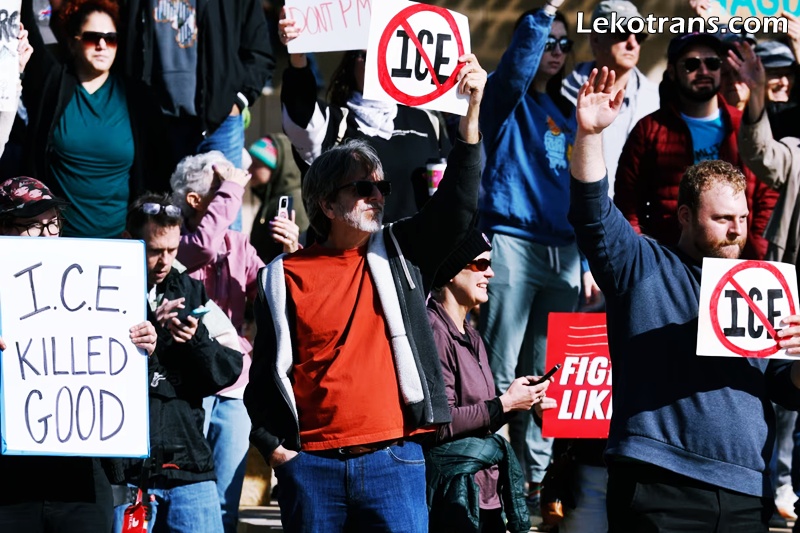
A nationwide wave of protests erupted Saturday following the killing of Renee Nicole Good, a 37-year-old Minneapolis woman and mother of three, by an Immigration and Customs Enforcement (ICE) agent—an incident that has intensified public outrage over federal immigration enforcement tactics under President Donald Trump’s sweeping crackdown. Demonstrations stretched from coast to coast, with protesters demanding justice for Good, accountability for federal agents, and the removal of ICE from local communities.
In Minneapolis, the epicenter of the unrest, snow flurries fell as thousands of demonstrators gathered in parks, marched through residential neighborhoods, and rallied outside federal buildings. Chants of Good’s name echoed through the streets, transforming her death into a powerful symbol of broader concerns over federal authority, the use of force, and the presence of immigration enforcement agencies in U.S. cities.
Good was fatally shot early Wednesday morning during an ICE operation, according to authorities. Details surrounding the circumstances of the shooting remain under investigation, but the incident has quickly become a flashpoint in national debates about policing, immigration enforcement, and federal oversight—particularly in cities that have sought to limit cooperation with ICE.
Similar protests unfolded across the country, from Los Angeles and New York to Washington, DC, El Paso, Boston, and dozens of smaller cities. Organizers with the “ICE Out for Good” national coalition said more than 1,000 demonstrations were planned nationwide over the weekend. The coalition, which includes advocacy group Indivisible, described the protests as a coordinated, nonviolent response to what it called a growing pattern of abuse and unchecked violence by immigration authorities.
“The response to ICE’s horrific killing of Renee Nicole Good is loud, peaceful, and inescapable,” Indivisible said in a Facebook post Saturday, accompanied by images of crowds filling streets and public squares in multiple cities. Coalition leaders said the demonstrations aim both to honor those who have died during ICE encounters and to demand meaningful accountability from federal agencies.
As protests intensified, the Department of Homeland Security announced an increased federal presence in Minneapolis. DHS Secretary Kristi Noem said on Fox News’ Sunday Morning Futures that “hundreds more” Customs and Border Protection officers would be deployed to the city.
“We’re sending more officers today and tomorrow,” Noem said. “There will be hundreds more in order to allow our ICE and our Border Patrol individuals that are working in Minneapolis to do so safely.”
The decision drew swift criticism from local and state leaders. Minneapolis Mayor Jacob Frey, who had strongly condemned the shooting last week and publicly urged ICE agents to leave the city, was told by Noem in a separate interview with CNN’s Jake Tapper that he and other officials needed to “tone down” their rhetoric.
Frey rejected that characterization, doubling down on his criticism in his own interview with Tapper on Sunday. He described the shooting as the result of “a federal agent recklessly using power that ended up in somebody dying,” and called for an independent investigation.
“And by the way, I shouldn’t be the one conducting the investigation, nor should Kristi Noem,” Frey said. “You should have an entity that is neutral, unbiased, and operating in reality with some common sense.”
Thousands protest across Minneapolis
Saturday’s demonstrations in Minneapolis began at Powderhorn Park, a historic gathering place that served as a central hub during the 2020 protests following the killing of George Floyd—an event that continues to shape the city’s relationship with law enforcement. From the park, thousands of protesters marched through nearby neighborhoods before converging on the street where Good was killed, holding a vigil at the site of her death.
Despite temperatures hovering near 20 degrees, demonstrators shared blankets and hot drinks while holding signs that read “ICE Will Melt,” “Justice for Renee,” and “It’s Not Very Pro-Life to Kill Our Neighbors.” Chants of Good’s name rang out repeatedly as speakers called for systemic reform and an end to federal immigration raids in local communities.
Elsewhere in the city, tensions escalated outside the Bishop Henry Whipple Federal Building, where daily protests have placed demonstrators in direct confrontation with ICE agents. Loud bangs were heard as federal agents fired pepper balls at a smaller crowd, according to CNN correspondent Omar Jimenez, who was at the scene.
Jimenez reported that law enforcement presence increased significantly after several incidents in which protesters threw snow and ice at vehicles or attempted to block them from leaving the facility. Demonstrations at the Whipple building have been more confrontational than others across the city, largely because of the close proximity between protesters and federal agents.
On Friday night, a separate downtown protest involving roughly 1,000 people saw some individuals break away from the main crowd and vandalize hotel windows, Minneapolis Police Chief Brian O’Hara said at a Saturday news conference. The hotels had reportedly been targeted because protesters believed federal agents were staying there.
More than 200 Minneapolis police officers and state troopers responded, detaining 29 people, who were cited and later released. One officer suffered minor injuries, O’Hara said.
Minnesota Gov. Tim Walz warned against escalating tensions, accusing the Trump administration of seeking to provoke disorder.
“Trump sent thousands of armed federal officers into our state, and it took just one day for them to kill someone,” Walz wrote on social media. “Now he wants nothing more than to see chaos distract from that horrific action. Don’t give him what he wants.”
Disputes over transparency and oversight
The protests unfolded amid a growing dispute over federal transparency. Three Minnesota Democrats—Reps. Ilhan Omar, Angie Craig, and Kelly Morrison—said they were denied access during an attempted oversight visit to a Minneapolis immigration facility on Saturday. Their visit came after a recent court ruling temporarily blocked a Trump administration policy that limited congressional access to such facilities.
The lawmakers said being turned away raised serious concerns about accountability and oversight at a moment when public trust in federal immigration enforcement is deeply strained.
Protests spread across the US
Large crowds were reported in major cities including Philadelphia, New York, Washington, DC, and Los Angeles, while smaller demonstrations took place in Portland, Sacramento, Boston, Denver, Durham, and Tempe, Arizona, where protesters lined a bridge overlooking a highway.
In Los Angeles, demonstrators marched through downtown Saturday afternoon carrying signs reading “ICE Out for Good” and chanting “Trump Must Go Now.” As night fell, about 150 protesters gathered outside a cluster of federal buildings along Alameda Street, displaying upside-down American flags and handmade anti-ICE posters. Police later issued a dispersal order, citing vandalism, and said several arrests were made, including one person detained on suspicion of battery against an officer.
On Sunday afternoon, dozens more protesters gathered outside a Home Depot near the 110 Freeway, holding signs that read “ICE Out of LA,” “Boycott The Home Depot,” and “Keep Families Together.”
In Washington, DC, demonstrators marched in steady rain outside the White House, calling for state-level oversight of ICE and condemning what they described as aggressive federal immigration tactics.
“I’m deeply concerned about the 10th Amendment being downtrodden by this administration and about the lives of common American citizens being endangered,” said Jack McCarty, a protester originally from Minnesota. He argued that independent, state-level oversight of ICE operations is essential to preventing future deaths like Good’s.
In Austin, Texas, protesters confronted armed officers outside a federal building, according to CNN affiliate KEYE. Officers wearing helmets and masks stood guard with batons as demonstrators voiced frustration over what they see as militarized immigration enforcement.
“I’m glad we’re taking to the streets,” protester David Whitfield told KEYE. “This is the type of action we need right now. The turnout could be bigger, but people are finally speaking up.”
As investigations into Renee Good’s death continue, her killing has galvanized a national movement—one that shows no sign of slowing, as communities across the United States grapple with questions of justice, accountability, and the role of federal power in everyday life.